President Trump Opens Asia Trip by Securing Landmark Wins for America
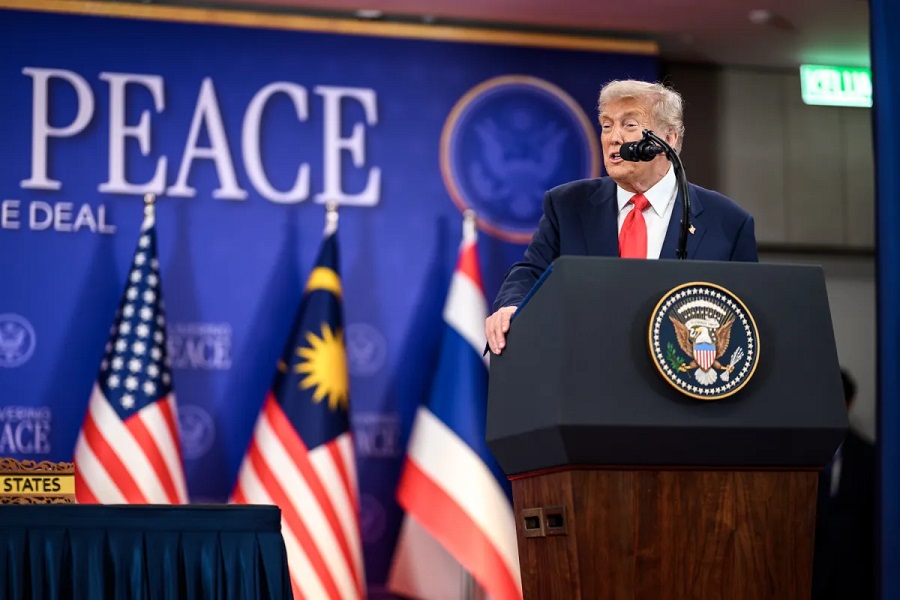
KUALA LUMPUR — October 27, 2025 U.S. President Donald Trump began his latest Asia tour this weekend with a flurry of trade and investment announcements, signing sweeping agreements with several Southeast Asian nations aimed at boosting American exports, securing access to critical minerals, and countering China’s influence in the Indo-Pacific region.
The deals, finalized at the 47th Association of Southeast Asian Nations (ASEAN) Summit in Kuala Lumpur, mark one of the most ambitious trade offensives of Trump’s second term.
The United States signed comprehensive trade deals with Malaysia and Cambodia, while establishing framework agreements with Thailand and Vietnam to be finalized in the coming months.
Under the terms of the new pacts, U.S. tariffs on Southeast Asian imports will be gradually reduced, with a baseline tariff rate of 19% for Malaysia, Thailand, and Cambodia, and 20% for Vietnam. Selected sectors — including digital technology, semiconductors, and renewable energy — are expected to see tariff exemptions over the next five years.
The agreements also include extensive cooperation on critical minerals, a sector now at the heart of global economic and security competition.
Malaysia and Thailand committed to ensuring stable U.S. access to rare-earth elements used in electric vehicles, defense systems, and consumer electronics.
In addition, Thailand signed letters of intent to purchase 80 U.S.-made aircraft, valued at approximately $18.8 billion, and committed to increasing annual imports of U.S. energy products by $5.4 billion.
Cambodia’s agreement includes provisions for agricultural exports, infrastructure investment, and joint anti-counterfeiting initiatives.
“This is the golden age of America,” Trump declared during a press conference at the Kuala Lumpur Convention Centre.
“Our partnerships across Southeast Asia will bring incredible prosperity — not just for our friends here, but for American workers, factories, and farmers back home.”
Analysts say the moves reflect a calculated attempt to reassert U.S. influence in a region long considered economically dominated by China. By strengthening trade and investment ties, Washington hopes to diversify supply chains away from Chinese control and secure alternative sources for strategic materials.
“Trump’s Southeast Asia tour is about much more than economics — it’s about geopolitics,” said Dr. Elaine Morris, a senior fellow at the Pacific Trade Institute.
“The rare-earth and technology supply-chain components of these deals directly target one of China’s main sources of leverage.”
The new commitments come just days before Trump is scheduled to meet Chinese President Xi Jinping in Seoul, where both leaders are expected to discuss tariffs, technology transfers, and global energy markets.
While Malaysia and Cambodia have embraced closer trade ties with Washington, Thailand and Vietnam are proceeding more cautiously. Both nations maintain extensive economic relationships with China and are wary of being drawn into a U.S.–China rivalry.
Vietnamese officials emphasized that their framework deal “remains consistent with Vietnam’s independent foreign policy and regional economic commitments.”
For ASEAN countries, the U.S. offers an attractive counterbalance to Beijing’s dominance. Still, experts caution that implementation challenges and political shifts could slow progress.
“Announcing multi-billion-dollar trade deals is the easy part,” said Rajiv Goh, an economist at the Singapore Centre for Strategic Studies.
“Turning those memoranda into real investments and exports requires stability, enforcement, and trust — all of which will be tested.”
The trade announcements were met with optimism on Wall Street, where U.S. defense and energy stocks saw a modest uptick in pre-market trading. However, critics at home questioned whether the benefits would materialize quickly enough for American manufacturers facing high inflation and global competition.
Democratic lawmakers also criticized the administration’s approach as overly transactional.
“These deals may look good on paper,” said Senate Minority Leader Maria Torres, “but without binding labor and environmental standards, they risk repeating the mistakes of past trade wars.”
Meanwhile, business leaders in Southeast Asia have praised the agreements as a “reset” in regional cooperation. “The U.S. is back in the game,” said Thai Chamber of Commerce Chairman Suriya Patthanapong.
“This opens doors for both sides — if everyone follows through.”
Attention now turns to Trump’s upcoming summit with Xi Jinping, where trade tensions are expected to take center stage. U.S. officials are reportedly preparing proposals for tariff reductions contingent on Chinese compliance with rare-earth and intellectual property provisions.
Observers also expect further discussions on expanding the Indo-Pacific Economic Partnership, a framework introduced last year as a replacement for the Trans-Pacific Partnership (TPP) that the U.S. withdrew from in 2017.
In the coming months, negotiators from Washington and regional capitals will work to finalize the framework agreements with Thailand and Vietnam. Success could pave the way for the most significant expansion of U.S.–ASEAN trade relations in more than a decade.
President Trump’s Asia tour marks a renewed push to reshape America’s trade architecture in the Indo-Pacific. By targeting critical minerals, high-tech manufacturing, and energy cooperation, Washington is positioning itself for long-term strategic competition with China.
Whether the ambitious deals signed this week lead to lasting partnerships or political friction will depend on how quickly they move from announcement to action.
For now, the message from Kuala Lumpur is clear: the United States is back — and it’s buying big.